A Weekend to Reflect on What It Means to “Be FMM Today”

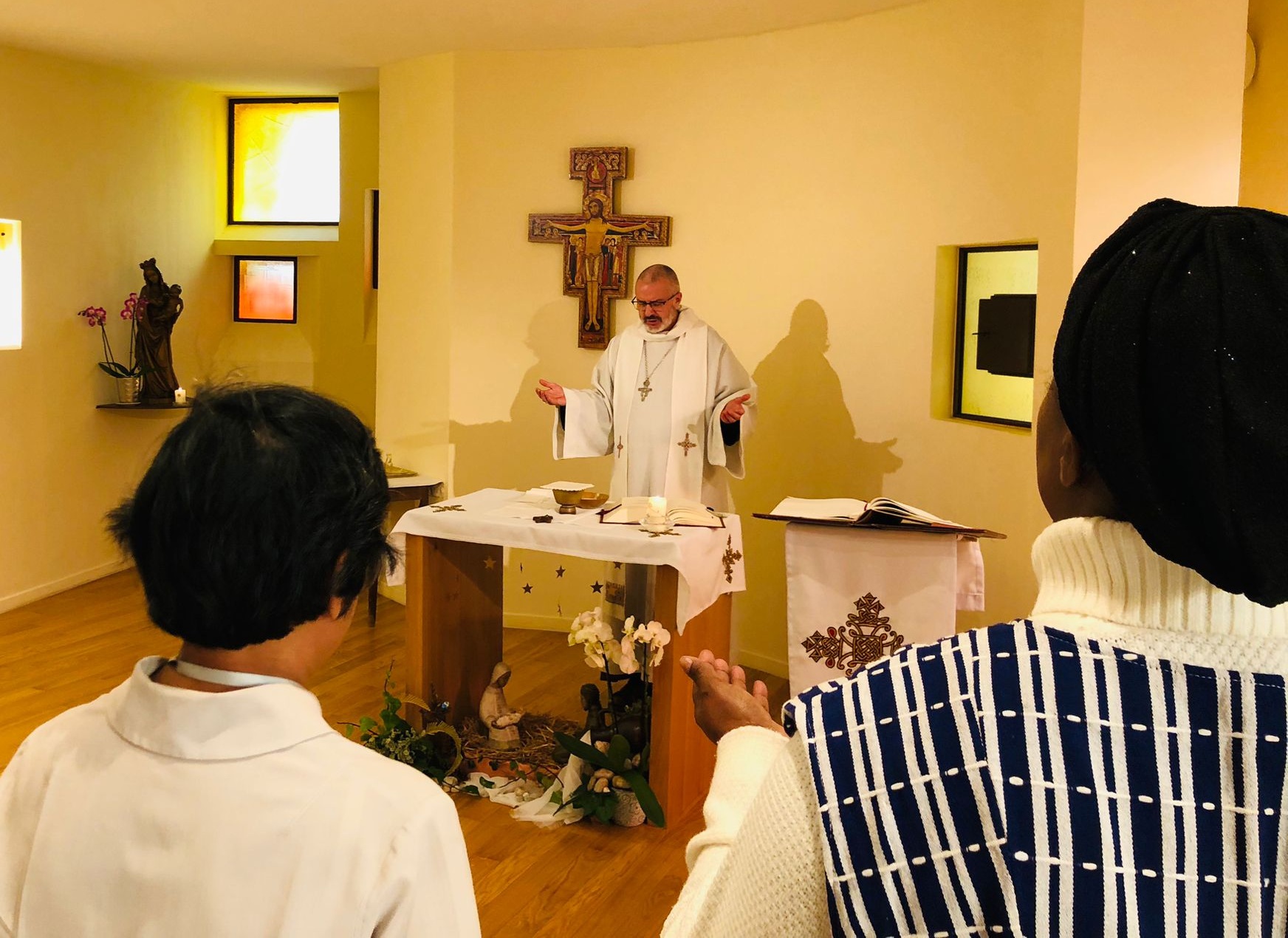
A group of sisters under the age of fifty-five gathered for a time of renewal with Éric Bidot, in a spirit marked by Franciscan spirituality. Through teachings, prayer, Mass, and small-group sharing, the aim was to reflect on what it means to “be FMM today” in the contemporary world, in the light of Francis of Assisi and the calls of the Church.

One of the main threads running through the weekend was the question of how we look: how do we look at the world, the Church, people, our mission, and ourselves? Mgr Bidot led us to revisit the Second Vatican Council, particularly through Gaudium et Spes and the well-known expression “the signs of the times.” In this perspective, religious life is not removed from reality but engaged in a humble and courageous encounter between faith and life. Paul VI said in an audience on March 15, 1970, that the Council invited the Church to turn toward the good present in the world, to recognize it, rejoice in it in God, and sing its praise: “The Council is oriented toward the good—the good that exists—to recognize it, rejoice in it in God, and sing its praise.”

An essential dimension was the practice of the Franciscan gaze. Francis was never a disconnected idealist; his gaze was both realistic and compassionate. He knew how to name suffering, wounds, sin, and injustice, without reducing the world to its darkness. To see the good is to recognize that it is already there—sometimes small, fragile, and discreet—and to rejoice in it. To see evil is to name it without complacency and to desire its conversion. The Franciscan does not ignore the shadows but refuses to dwell in them. This gaze—one of compassionate optimism rather than superiority—holds together lucidity and hope, denunciation and admiration, truth and gentleness. It stands in contrast both to naïve idealism and to the harsh or cynical criticism so widespread in our cultural environments. True optimism means judging evil honestly and naming it, while remaining oriented toward the search for the good.

This attitude of gaze is rooted in a Christian anthropology in which God acts not only in the soul but also in the body and in affectivity. We reflected on the idea that affectivity is not a secondary area but a place where grace is expressed: what do I allow to dwell within me? What nourishes my emotions? What do I choose to contemplate? This inner discernment is profoundly missionary, because we always carry out our mission with what we are and with what we take in. As it is written in Epistle to the Philippians (4:8–9): “Finally, brothers and sisters, whatever is true, whatever is noble, whatever is right and pure, whatever is worthy of love and honor, whatever is virtuous and praiseworthy—think about such things.”

The relationship with creation also naturally took an important place, in line with Laudato si’, where Pope Francis echoes Saint Francis. Creation is not merely a backdrop but a language; it reveals a humble mysticism—the mysticism of a leaf, a path, the dew, the gaze of the poor. Learning to see the good at work is learning to see God in what He has made and in what He continues to do. Here again, Franciscan spirituality invites us to a broadened realism: to see beauty, but also to measure the wounds inflicted on creation and on humanity.

Finally, the weekend strongly emphasized the desire for the Spirit. Francis often exhorts his brothers to “desire the Spirit of the Lord”—a desire that engages body, soul, and spirit. Desire is not a vague feeling but an active openness, a way of making space within so that the Spirit can act. God does not use us as passive instruments: He acts in us and brings us into being, but we cooperate. Mission is always a partnership.

What we take away for our FMM vocation today could be expressed like this: to be women capable of seeing deeply and truthfully, of discerning the good in a world sometimes marked by harshness or discouragement, of naming evil without hatred or denial, of helping the good to grow and rejoicing in it. To be Franciscan missionaries is not to flee reality, but to inhabit it in a way that allows God to shine through. It means accepting to form our gaze, to educate our affectivity, to grow in spiritual freedom, and to remain open to the Spirit. It is choosing to believe that good exists, that it can be born or reborn, that it can be spoken, shown, and offered—not out of naïveté, but out of fidelity to the way of Francis, who knew how to encounter lepers, the poor, and the wounded Church of his time.

Ultimately, this weekend reminded us that Franciscan mission is not only an external activity, but a way of being present in the world: a posture of lucid compassion, joyful recognition, responsible discernment, and embodied hope.

Leave a Reply