
6 August 2026
On Wednesday 22 July, the vast Landes de Gascogne forest in south-western France, mainly made up of pine trees, caught fire following a forestry accident and extreme weather conditions, after three heatwaves since May.
Within just a few days, an area equivalent to four times the size of Paris had gone up in smoke (42,500 hectares).
The work carried out by firefighters, farmers, the military and water-bombing aircraft was immense, while the national and international solidarity was remarkable and unwavering. From the very first days, faced with the scale of the fire and the speed at which it was spreading, towns and villages between the Atlantic Ocean and Bordeaux were gradually evacuated.
By Friday evening, thick, acrid smoke covered the city of Bordeaux. Thousands of people — 220,000 in total — had to leave their homes, often at very short notice and with the anxiety of not knowing what they would find when they returned.
It was an unprecedented situation, but one which meant that there were no casualties among the population. The Bordeaux Exhibition Centre, with its three large halls covering more than 60,000 m², was entirely dedicated to welcoming people displaced by the fires.
While police officers and gendarmes ensured everyone’s safety, civil protection services, humanitarian organisations and hundreds of volunteers organised themselves to welcome and care for the thousands of evacuees.
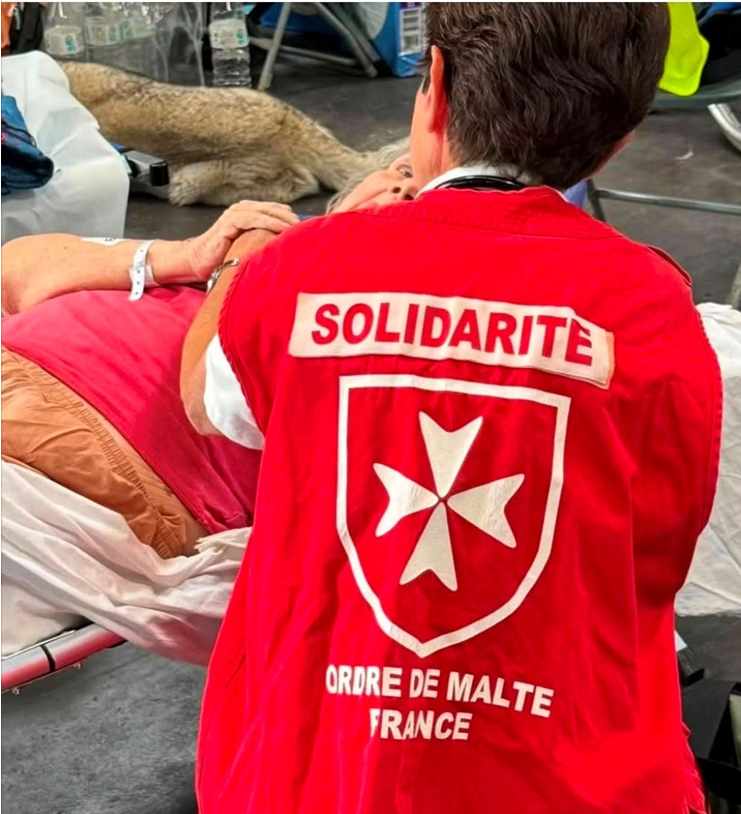
I went there on Sunday 26 July, joining the teams as a doctor working with the Order of Malta, in collaboration with the first-aid workers on site.
The atmosphere in this huge hall, bustling with people and filled with hundreds of camp beds on which people lay looking dazed and anxious, was striking. I felt like a drop of water in the midst of a blaze, with one prayer in my heart: send me to the heart that is waiting.
I expected to provide medical care, practical help and advice, but instead I found myself sitting for hours holding the hands of elderly people who had been evacuated from care homes. Already disorientated, they felt even more lost in such an anonymous and uncomfortable place.
Wearing wristbands and identified by numbers, they became once again unique and beloved individuals, thanks to this wave of solidarity that drew us towards them.
Others, completely disorientated and having left home without their medication or prescriptions, simply needed someone to listen to them and offer a little advice, helping them reconnect with a reality that, in the end, was inhabited and began to make sense again.
As I left, I was filled with one certainty: through God, I had been in the right place at the right time!
Valérie Gauthier, FMM – Bordeaux